Hungary dual citizenship: complete guide
Foreigners often seek second citizenship as a backup plan for unforeseen circumstances in their home country, to simplify international travel, or to relocate to a country with a higher standard of living. A Hungarian passport fulfils all these needs.
Most commonly, citizenship in Hungary is obtained by naturalisation. Hungarian laws do not mandate renouncing one's original citizenship upon acquiring a Hungarian passport. However, under a 2025 law, Hungary may suspend the citizenship of dual nationals who pose a threat to public order, safety, or national security.



- Does Hungary allow dual citizenship?
- How does dual citizenship differ from second citizenship?
- 9 benefits of Hungarian dual citizenship
- All pathways to Hungarian citizenship in detail
- Hungary dual citizenship for Americans
- Dual citizenship in Hungary for Canadians
- Hungarian dual citizenship for UK citizens
- Dual citizenship in Hungary for Australians
- Residence permit: the first step towards Hungary dual citizenship
- Life in Hungary for dual citizens: practical aspects
- Key points about Hungarian dual citizenship
- Frequently asked questions

Does Hungary allow dual citizenship?
Hungary allows dual citizenship. Individuals do not have to give up their original nationality when acquiring a Hungarian one. A Hungarian passport can be held alongside other national passports, if the other countries also permit dual or multiple citizenship.
Dual citizens’ status in Hungary
Under Hungary dual citizenship law, dual citizens are treated solely as Hungarian nationals. Their rights and responsibilities in Hungary are assessed based on their Hungarian status.
A new law passed in 2025 introduced the option to suspend Hungarian citizenship for dual nationals who also hold a non-EEA passport and are considered a threat to public order, public safety, or national security.
Grounds for suspension include working for a foreign military or intelligence service, involvement with terrorist organisations, and conviction for crimes like treason or terrorism. The suspension can last up to 10 years and may be reviewed and appealed in administrative court.
Dual citizenship rules in other countries
Whether dual citizenship is allowed depends on the law of the other country. Countries that allow second citizenship include the USA, the UK, Australia, Canada, Turkey, and Portugal.
Examples of countries that prohibit having two or more passports include China, Spain, and Austria. In these cases, original citizenship may be automatically lost or revoked upon acquiring a Hungarian passport.
Ways to obtain Hungarian dual citizenship
Foreigners can obtain Hungarian citizenship through several pathways, including birth, descent, marriage, or naturalisation. Naturalisation usually requires long-term residence, a stable income, and knowledge of the Hungarian language.
To obtain a Hungarian passport by naturalisation, a foreigner must reside in Hungary at least for 3 years with temporary residency and at least 8 years with a permanent status.
Not every residence permit in Hungary allows obtaining permanent residency and citizenship. Residence permit types leading to a permanent status include permits for high-skilled workers, the National Card, and the Hungary Golden Visa which is granted for investment of at least $250,000.

How does dual citizenship differ from second citizenship?
Dual citizenship and second citizenship refer to distinct concepts, primarily differentiated by military obligations.
Dual citizenship occurs through special agreements between countries, allowing individuals to hold citizenship in both places without facing double military duties. Essentially, a person with dual citizenship is required to perform military service in just one of the countries, if at all.
However, Hungary has not signed such dual citizenship agreements with any other country.
Second citizenship is acquired when a person becomes a citizen of another country, provided the laws of both the original and the new country permit it. Unlike dual citizenship, there's no agreement to limit military obligations to one country, meaning an individual may be subject to military service requirements in both countries, if applicable.
Yet, obtaining Hungary citizenship cannot lead to a military obligation, as Hungary abolished mandatory military service in 2004. Now, serving in the Hungarian army is entirely voluntary and based on contracts.

9 benefits of Hungarian dual citizenship
1. Relocation to Hungary
Hungarian citizenship grants the right to live in Hungary without a residence permit. Naturalised citizens can move with their spouses and children and enjoy the same rights as native Hungarians.
Hungary ranks 17th among the world’s safest countries, according to the Global Peace Index 2025. The country provides a stable environment and is a convenient base for work, study, or retirement in Central Europe.
2. Visa-free travel
Hungarian citizens enjoy visa-free or visa-on-arrival access to 171 countries, including the Schengen Area, the United Kingdom, and Japan. For the United States, Canada, and Australia, they need only to obtain an Electronic Travel Authorization, or eTA.
3. Opportunities in the EU and EEA
As an EU member state, Hungary allows its citizens to live, work, and start businesses in any EU and EEA country with minimal formalities. To relocate within the EU, a Hungarian citizen only needs to purchase or rent property and register their residence.
4. European healthcare access
Hungary offers access to free European healthcare through a compulsory medical insurance system. This system covers treatments in state clinics and hospitals and adheres to EU standards. Free medical coverage is provided to children up to 16 years old, students, and retirees. Other citizens contribute a portion of their income to the health insurance fund monthly.
5. Access to free European education
Hungarian citizens have access to free education in Hungary's public schools and universities. Additionally, they benefit from lower tuition fees at universities across Europe compared to non-EU students.
6. Affordable cost of living
Hungary’s cost of living is lower than in most Western European countries. Monthly expenses without rent average €650 per person, or about €2,300 for a family of four. Property prices in central Budapest average at €4,100 per square metre, while prices in cities like Copenhagen exceed €8,000. Daily costs for groceries, entertainment, and transport are up to 50% lower than in countries like the Netherlands or Switzerland.
7. Bank accounts in Europe
Opening bank accounts in Europe can be challenging for foreigners, who may be perceived as high-risk for money laundering by banks. However, Hungarian citizens enjoy the ease of opening accounts in EU banks and in Switzerland, facing fewer such barriers.
8. Tax optimisation
Hungary offers a flat personal income tax rate of 15%. There is no wealth tax and no inheritance or gift tax on direct family property transfers. Hungary’s corporate tax rate is 9%, the lowest in the EU. Stamp duty on property purchases is 4%.
9. Citizenship for children
Children of Hungarian citizens automatically qualify for a passport if they were under 18 when their parents acquired citizenship or if they were born after that time.
All pathways to Hungarian citizenship in detail
1. Birth
Children automatically acquire Hungarian citizenship if at least one parent is a Hungarian citizen, regardless of where the child is born. This also applies to children under 18 adopted by Hungarian citizens and children found in Hungary whose parents are unknown.
2. Repatriation or descent
Citizenship can be acquired by individuals who, or whose ancestors, were born or lived in historic Hungarian territories before 1920 or between 1938 and 1945. This eligibility extends to their children, grandchildren, and great-grandchildren.
Historical Hungarian territories encompass areas such as Southern Slovakia, Transylvania in Romania, Zakarpattia Oblast in Ukraine, and Vojvodina in Serbia.
The process for obtaining citizenship by repatriation does not require the applicant to reside in or relocate to Hungary. To qualify, applicants must prove Hungarian ancestry and basic knowledge of the Hungarian language.
3. Investment
Hungary does not offer direct citizenship by investment. However, foreigners can obtain a residence permit under the Hungary Golden Visa program by investing at least €250,000.
After maintaining a resident status for 3 years, individuals may become eligible to apply for permanent residency. Following an additional 8 years of permanent residency, they can then apply for citizenship by naturalisation.
4. Marriage
Spouses of Hungarian citizens can apply for citizenship after 3 years of marriage and cohabitation in Hungary. They must meet general requirements, including a clean criminal record, income verification, and Hungarian language skills.
If the marriage was registered outside Hungary, it must also be registered domestically. If the couple lives abroad, the required marriage period increases to 10 years or 5 years if they have a child.
5. Naturalisation
Foreigners can apply for citizenship after living in Hungary for 11 years: 3 years with a qualifying temporary residence permit and 8 years with permanent residency. Applicants must pass a citizenship exam and demonstrate knowledge of Hungarian language, history, and constitution. They must also have a clean criminal record, stable income, and a registered permanent address.
In some cases, shorter residency periods apply. Individuals who were born in Hungary or received a residence permit before the age of 18 become entitled to citizenship after 5 years. Spouses of Hungarian citizens, parents of Hungarian children, refugees, and stateless persons may apply after 3 years. Minor children receive citizenship automatically with their parents.
6. Declaration
This simplified path applies to individuals who:
- lost citizenship due to emigration between September 15th, 1947 and May 2nd, 1990;
- were born in Hungary to non-Hungarian parents and did not acquire any other citizenship at birth;
- were born before October 1st, 1957, to a Hungarian mother and foreign father, and did not become Hungarian citizens by birth.
The application is submitted to the Ministry of the Interior. The Ministry of Interior takes a minimum of 3 months to review the declaration.
Comparison of Hungarian citizenship pathways
| Pathway | Residency requirement | Citizenship test required | Key eligibility condition |
|---|---|---|---|
| Birth | None | No | At least one parent is a Hungarian citizen |
| Repatriation | None | No | Hungarian ancestry with proof of origin, knowledge of Hungarian language |
| Investment | 11 years | Yes | €250,000+ investment, legal residence, then standard naturalisation |
| Marriage | 3, 5, or 10 years | No | Marriage to a Hungarian citizen and cohabitation or children together, knowledge of Hungarian language |
| Naturalisation | 3, 5, or 11 years | Yes | Legal residence, income and housing proof |
| Declaration | None | Yes | Lost citizenship, born stateless, or specific historical cases |
How to get dual citizenship in Hungary by naturalisation
Obtaining Hungarian citizenship by naturalisation requires living in Hungary on a residence permit for at least 3 years and then as a permanent resident for at least 8 years.
While there are multiple residence permit types in Hungary, not all lead to permanent residency or citizenship. Short-term or seasonal permits do not qualify. In contrast, residence permits for high-skilled workers or investors may offer a path to long-term stay and naturalisation.
Here is how an investor can get Hungary citizenship by naturalisation using the Hungary Golden Visa program.
To acquire a Golden Visa in Hungary, an applicant first secures a Guest Investor Visa. Within three months of their initial entry using this visa, they are required to invest a minimum of €250,000 in the Hungarian economy.
The Golden Visa, once issued, remains valid for up to 10 years, provided that the applicant maintains their investment in Hungary for at least five years.
Foreigners applying for permanent residence in Hungary must ensure they do not leave the country for more than four consecutive months. Additionally, their total time spent outside Hungary should not exceed 270 days.
Applicants must show that granting them permanent residence aligns with Hungary’s interests and demonstrate Hungarian language proficiency.
After residing in Hungary for at least 8 more years, individuals may apply for Hungarian citizenship by naturalisation. The residency period is counted from the date of registering a permanent residence address in Hungary.
Hungary dual citizenship for Americans
Dual citizenship is permitted for Americans, allowing them to obtain Hungarian citizenship without giving up their US passport.
In the United States, individuals holding dual citizenship are primarily recognised as American citizens. Dual nationals must use their US passport to enter and leave the United States.
American citizens are subject to US taxation on worldwide income, regardless of their place of residence. This means Americans must report and potentially pay taxes on income earned abroad. Since the termination of the double taxation avoidance treaty between the USA and Hungary on January 1st, 2024, citizens may be subject to taxation on the same foreign income in both countries.
Dual citizenship in Hungary for Canadians
Canada permits dual citizenship, thus, Canadian nationals can acquire Hungarian citizenship without renouncing their Canadian passport. Canadians may travel with either passport, depending on their destination, but must use their Canadian passport when entering or leaving Canada.
Hungary and Canada signed a double taxation agreement in 1992. Under this treaty, income earned in Hungary by Canadian citizens is not taxed twice. Taxes paid in Hungary can be credited against Canadian tax obligations, and vice versa. This arrangement helps avoid financial disadvantages for dual nationals living or working across both countries.
While in Hungary, Canadian-Hungarian dual citizens are treated solely as Hungarian citizens under Hungarian law. Canadian diplomatic assistance is generally not available to them within Hungary, but it may be provided when they are in a third country.
Hungarian dual citizenship for UK citizens
Dual citizenship is recognised in the UK, allowing British citizens to retain their original passport when applying for Hungarian citizenship.
Holding a Hungarian passport grants British citizens all the rights and privileges associated with UK citizenship, including the right to reside in the UK permanently, and the freedom to leave and re-enter the UK at will.
The UK and Hungary have maintained a double taxation treaty since 2011, ensuring that Hungarian citizens do not pay income tax twice on the same earnings. If they pay income tax in the UK, they are not taxed again in Hungary. Instead, the tax paid in the UK can be deducted from their Hungarian tax obligations.
Hungarian citizens cannot receive diplomatic assistance from the British government while in Hungary. However, they are eligible for diplomatic protection from both the UK and Hungary when in a third country, where neither has jurisdiction.
Dual citizenship in Hungary for Australians
Australia allows dual citizenship, meaning its citizens are not required to give up their original passport to acquire another nationality. Australian citizens are required to use their Australian passport for entering and leaving Australia, but they may use a Hungarian passport for travel elsewhere.
Since 1992, Australia and Hungary have upheld a double tax agreement. This agreement prevents double taxation by exempting income in Hungary that is subject to taxation in Australia. Conversely, Australia permits its citizens to credit taxes paid in Hungary against their Australian tax obligations.

Residence permit: the first step towards Hungary dual citizenship
Residency in Hungary is not exclusive to its citizens; foreigners can obtain a residence permit for relocation. The entry and residence of third-country nationals are regulated by the relevant Hungarian law.
Hungary Golden Visa offers two pathways to a residence permit:
- Investment of at least €250,000 in investment fund units.
- A donation of at least €1,000,000 to a higher education institution.
Additionally, popular alternatives for gaining residency include:
- proof of external income of at least €3,000 a month;
- starting a business or engaging in entrepreneurship within Hungary;
- employment with a Hungarian company;
- marriage to a Hungarian citizen.
A residence permit is usually granted for up to 5 years and can be renewed. To maintain most types of residence permits, holders must spend at least 9 months per year in Hungary. These stay requirements also apply to those who wish to apply for permanent residence after 3 years.
The Hungary Golden Visa offers more flexible terms. It provides a longer validity period of 10 years. To extend or renew the permit, investors do not need to meet physical stay requirements — they only need to confirm that the investment conditions are still met.

Life in Hungary for dual citizens: practical aspects
Dual citizens living in Hungary enjoy full rights of Hungarian nationals. They can access public healthcare, education, social security, and own property without restrictions. They may also work, run a business, and participate in public life on the same terms as native citizens.
Registration and documents
Residents must register their address with the local municipality. After registration, they receive a Hungarian ID card, tax number, and health insurance card. These are required for opening a bank account, signing rental agreements, or visiting doctors.
Cost of living
Hungary is one of the most affordable EU countries. Monthly living costs for one person average €650, excluding rent. A one-bedroom apartment in Budapest costs €500—700 per month, while in smaller cities like Debrecen or Szeged prices range from €300 to €500.
According to Eurostat’s 2024 price level index, Hungary’s overall price level for household consumption is just 73.5, well below the EU average of 100. It is the fourth-lowest in the EU, ahead of only Romania, Bulgaria, and Poland. Consumer prices for food, energy, clothing, and transport are often 30—50% lower than in Western Europe.
Driving and transport
Hungarian dual citizens can exchange their foreign driving licence for a Hungarian one. Public transport in Hungary is efficient and affordable, with discounts available for students and seniors. A public transport pass in Budapest costs about €23 per month.
Language and communication
While Hungarian is the official language, English is widely spoken in big cities and by younger people. However, knowing basic Hungarian is useful when dealing with public offices and service providers.
Taxation
Dual citizens residing in Hungary are subject to local tax regulations. Those who spend more than 183 days per year in Hungary are considered tax residents. They must report their worldwide income and may be subject to Hungarian tax rules. Hungary has tax treaties with over 80 countries to avoid double taxation.
Voting rights
Dual citizens can vote in Hungarian national and local elections. They may also stand as candidates for elected office if they meet all legal requirements.
Key points about Hungarian dual citizenship
- Investors who obtain the Hungary Golden Visa can subsequently apply for a Hungarian passport.
- Hungary permits second citizenship, but the country does not have any formal agreements regarding dual citizenship with other nations.
- American, Canadian, British, and Australian citizens are not required to renounce their original passports to get citizenship in Hungary.
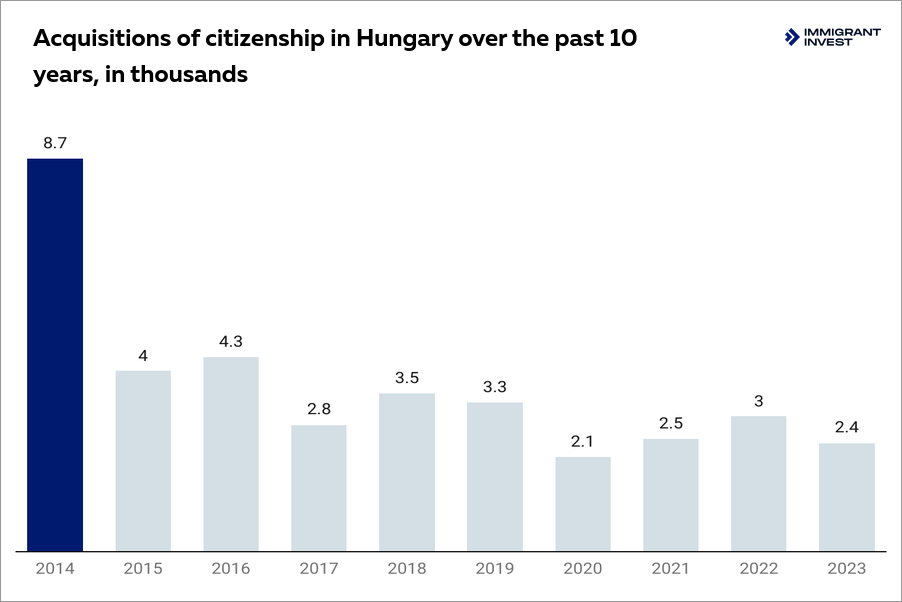
- Hungarian citizenship by naturalisation is granted after 11 years. In some cases, the period may be reduced to 3 or 5 years.
- Foreigners are allowed to live in Hungary with a residence permit. Obtaining a Hungarian passport is not mandatory.
Frequently asked questions
Where is dual citizenship not allowed?
Dual citizenship is not allowed in several countries, including China, Austria, Spain, and the UAE, among others. In these countries, laws prohibit citizens from holding dual or multiple citizenships.
Conversely, dual citizenship is permitted in countries such as Hungary, Portugal, Turkey, the USA, the UK, Australia, and Malta.
Which second citizenship is the easiest to obtain?
The easiest second citizenships to obtain are often through citizenship-by-investment programs, particularly in Caribbean countries and Vanuatu. These programs allow foreigners to gain citizenship usually within a few months, starting at investments of at least $130,000.
Hungary does not offer direct citizenship by investment. However, investors may apply for citizenship by naturalisation after obtaining a Hungary Golden Visa. The minimum investment is €250,000.
Where is it easiest to obtain citizenship in Europe?
The ease of obtaining citizenship in Europe depends on the legal grounds and each country’s rules. For example, in Hungary, one of the fastest ways to obtain citizenship is by repatriation. Foreigners with Hungarian ancestry can apply if they speak basic Hungarian. The process may take just a few months and does not require residence in Hungary.
For those without Hungarian roots, citizenship is available by naturalisation after 11 years of residence. One way to start this path is through the Hungary Golden Visa. It requires an investment of at least €250,000 in a government-approved real estate fund.
How difficult is it to get Hungarian citizenship?
The ease of obtaining Hungarian citizenship depends on the chosen pathway. Citizenship by descent or through Hungarian ancestry is relatively simple and does not require living in Hungary. Standard naturalisation takes over 11 years of legal residence and includes passing a language and citizenship test. The process is strict but manageable if all requirements are met.
Why is a second citizenship needed?
Second citizenship is often obtained to provide a backup plan for unforeseen circumstances, simplify travel around the world, or relocate to a country with a higher quality of life and better opportunities. Second citizenship can also help with tax optimisation.
Can you have three citizenships?
Yes, many countries allow dual and multiple citizenships, including Hungary, the US, Canada, and the UK. This means a person can legally hold three or more nationalities at the same time.
However, not all countries permit this. For example, China, India, and Austria generally do not allow their citizens to acquire additional citizenships without losing their original one. It is important to check the specific laws of each country involved.
Does Hungary allow dual nationality?
Yes, Hungary allows second citizenship, but the country does not have any formal agreements regarding dual citizenship with other nations.
Can I have dual citizenship in the US and Hungary?
Yes, you can. Both the US and Hungary allow their citizens to hold passports from other countries.
Who is eligible for Hungarian citizenship?
Citizenship in Hungary can be obtained by repatriation for those with Hungarian ancestry or by naturalisation after long-term residence. It’s also available to spouses of Hungarian citizens and certain individuals through declaration, such as former citizens or stateless people born in Hungary.
Do you have to speak Hungarian to get Hungarian citizenship?
Yes. All applicants must prove basic knowledge of the Hungarian language unless exempt. Those applying through repatriation or marriage are tested informally, while standard naturalisation requires passing a formal citizenship exam in Hungarian.
How long does it take to get Hungarian citizenship?
It takes at least 11 years through standard naturalisation: 3 years of temporary residence plus 8 years of permanent residency. Some applicants qualify for shorter periods of 5 or 3 years based on birth in Hungary, marriage, or parenthood. The application process itself may take several months after submission.
How many citizenships can Hungarians have?
Hungarian citizens are allowed to hold more than one citizenship simultaneously. However, it’s important to check the laws of the other countries involved, as they might have varying regulations concerning dual or multiple citizenships.
Do Hungarian citizens need a visa to the USA?
To enter the United States, Hungarian citizens need to obtain an Electronic Travel Authorization, or eTA.
How strong is the Hungarian passport?
The Hungarian passport is one of the strongest in the world. It provides visa-free or visa‑on‑arrival access to over 170 countries, including all Schengen Area countries, the United Kingdom, Japan, and Singapore. Entry to the United States, Canada, and Australia requires only an electronic travel authorisation.
Can I lose my Hungarian citizenship?
Hungarian citizenship acquired by birth cannot be revoked. However, dual nationals who obtained citizenship on other grounds can lose it if it was obtained fraudulently. Starting June 2025, Hungary may also suspend citizenship for non-EEA dual nationals who pose a threat to national security, public order, or public safety. The suspension can last up to 10 years.